Have you ever wondered how your smartphone connects to the internet, makes video calls, streams movies, or downloads files so quickly over a 4G LTE network?
Behind all these activities is a powerful technology working silently in the background: EPC (Evolved Packet Core).
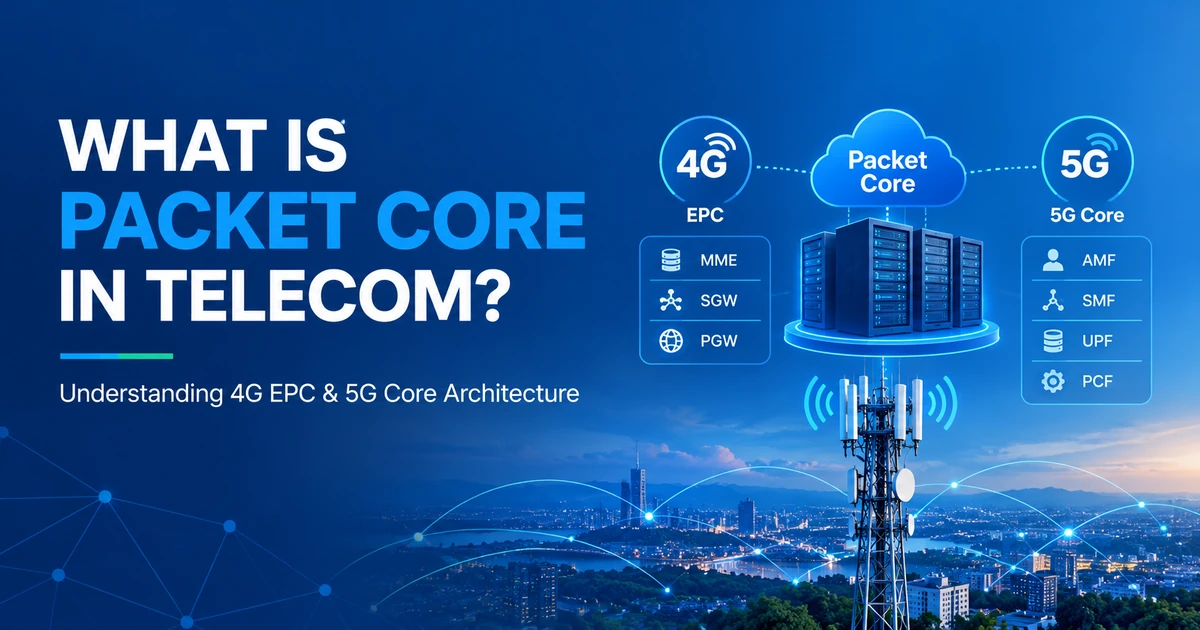
EPC is one of the most important components of a 4G LTE network. It acts as the central brain of the mobile network, managing user connections, handling data traffic, maintaining network security, and ensuring smooth communication between mobile devices and the internet.
Whether you are a telecom student, network engineer, IT professional, or simply curious about mobile technology, this blog will help you understand EPC in simple terms.
1. What is EPC in Telecom?
EPC stands for Evolved Packet Core.
It is the core network architecture introduced with 4G LTE (Long-Term Evolution) technology. Its primary responsibility is to manage data communication between mobile devices and external networks, such as the internet.
In simple words, EPC is the backbone of a 4G LTE network.
Whenever you use your smartphone to:
- Browse websites.
- Watch YouTube videos.
- Make VoLTE calls.
- Download applications.
- Send messages through online applications.
The EPC plays an important role in managing your connection and transferring data.
Unlike traditional 2G and 3G networks, which relied on separate circuit-switched and packet-switched domains, EPC uses an all-IP architecture. This means voice and data services can be delivered using IP-based technologies.
2. Why Was EPC Introduced?
Before 4G LTE, mobile networks primarily used 2G and 3G technologies.
These networks were designed to support voice calls and data services using different network architectures.
However, as smartphone usage increased, people started demanding:
- Faster internet speeds.
- Better video streaming quality.
- Lower network latency.
- Improved network capacity.
- Seamless connectivity.
- Better support for IP-based applications.
Traditional network architectures struggled to meet these growing requirements efficiently.
This is where EPC came into the picture.
EPC was designed to make mobile networks faster, simpler, more scalable, and more efficient.
Key objectives of EPC
| Objective | Explanation |
| High-speed connectivity | Supports faster mobile broadband |
| Low latency | Reduces communication delays |
| All-IP architecture | Uses IP-based communication |
| Mobility management | Maintains connectivity while moving |
| Network security | Protects users and network connections |
| Scalability | Supports growing numbers of subscribers |
3. EPC Architecture: Understanding the Main Components
To understand how EPC works, let’s first explore its major components.
An LTE network consists of two major parts:
- E-UTRAN: The radio access network that connects mobile devices to the network.
- EPC: The core network that manages connectivity, mobility, authentication, and data routing.
Let’s understand each component in simple language.
1. MME – Mobility Management Entity
MME stands for Mobility Management Entity.
It is the control-plane component of EPC and is responsible for managing subscriber mobility and network access.
Think of MME as the security and connection manager of the LTE network.
Main functions of MME:
- Manages user registration with the LTE network.
- Handles authentication and security procedures.
- Manages tracking area updates.
- Controls bearer establishment.
- Supports handovers between LTE base stations.
- Coordinates signaling between the user equipment and core network.
Example:
When you switch on your smartphone and it connects to a 4G network, the MME helps authenticate your device and manages the initial network registration process.
2. SGW – Serving Gateway
SGW stands for Serving Gateway.
It is a user-plane component that forwards data packets between the eNodeB and the Packet Data Network Gateway (PGW).
Think of SGW as a traffic forwarding point within the LTE network.
Main functions of SGW:
- Routes user data packets.
- Acts as a mobility anchor during handovers between eNodeBs.
- Forwards packets between the radio network and PGW.
- Buffers downlink packets during certain idle-mode procedures.
Example:
When you watch a video on your smartphone, the SGW helps forward the data packets between the LTE base station and the PGW.
3. PGW – Packet Data Network Gateway
PGW stands for Packet Data Network Gateway.
It provides connectivity between the LTE network and external packet data networks, such as the public internet.
Think of PGW as the gateway between your mobile network and the internet.
Main functions of PGW:
- Connects users to external IP networks.
- Allocates IP addresses to user equipment.
- Performs packet filtering.
- Supports charging and policy enforcement.
- Handles traffic routing.
- Supports Quality of Service (QoS) enforcement.
Example:
When you open Google on your smartphone, the PGW provides the connection between your mobile network and the internet.
4. HSS – Home Subscriber Server
HSS stands for Home Subscriber Server.
It is the main subscriber database in the LTE network.
Think of HSS as the digital record system that stores subscriber-related information.
Main functions of HSS:
- Stores subscriber profiles.
- Maintains authentication-related information.
- Stores subscription details.
- Supports user authentication.
- Provides subscriber information to the MME.
Example:
When you insert your SIM card and connect to a 4G network, the HSS helps verify your subscription and authentication information.
5. PCRF – Policy and Charging Rules Function
PCRF stands for Policy and Charging Rules Function.
It is responsible for making policy decisions and providing charging rules for network services.
Think of PCRF as the policy manager of the LTE network.
Main functions of PCRF:
- Controls network usage policies.
- Supports QoS management.
- Provides charging rules.
- Helps manage bandwidth allocation policies.
- Supports service-based traffic control.
Example:
A telecom operator may provide different Quality of Service levels for different services. PCRF helps determine the applicable policy and charging rules.
4. Difference Between Control Plane and User Plane
One of the most important concepts in EPC is the separation of the Control Plane and User Plane.
Let’s understand the difference.
| Control Plane | User Plane |
| Manages signaling | Handles actual user data |
| Controls network operations | Transfers data packets |
| Uses MME for major mobility and session management functions | Uses SGW and PGW for packet forwarding |
| Handles authentication and registration signaling | Handles browsing, streaming and downloads |
Simple example:
Imagine you are opening a website on your smartphone.
- The Control Plane helps establish and manage your network connection.
- The User Plane carries the actual website data to your device.
Both work together to provide a seamless internet experience.
5. How Does EPC Work? Step-by-Step Explanation
Now let’s understand how EPC works when you switch on your smartphone and connect to a 4G LTE network.
Step 1: Mobile Device Connects to LTE
When you switch on your smartphone, it searches for available LTE networks.
Your smartphone, also called User Equipment (UE), connects to a nearby LTE base station known as eNodeB.
Step 2: Network Registration
The eNodeB forwards the required signaling messages to the MME.
The MME manages the initial registration and coordinates authentication procedures.
Step 3: Subscriber Authentication
The MME communicates with the HSS to verify subscriber information and obtain the necessary authentication data.
If authentication is successful, the network allows the subscriber to access its services.
Step 4: Bearer Establishment
The network establishes the required bearer connections through the SGW and PGW.
A bearer provides a logical path for transferring user data with defined QoS characteristics.
Step 5: IP Address Allocation
The PGW allocates an IP address to the mobile device, enabling communication with external packet data networks.
Step 6: Internet Connectivity
Once the connection is established, your smartphone can access the internet.
The SGW and PGW forward user data packets between the LTE network and external networks.
The result? You can browse websites, stream videos, use social media, and access online applications through your 4G LTE connection.
6. Important Interfaces in EPC Architecture
EPC components communicate with each other through standardized interfaces.
Understanding these interfaces is important for telecom engineers and network professionals.
| Interface | Connected Components | Purpose |
| S1-MME | eNodeB – MME | Control-plane signaling |
| S1-U | eNodeB – SGW | User-plane data forwarding |
| S5/S8 | SGW – PGW | User-plane and control-plane connectivity |
| S6aS6a | MME – HSS | Subscriber authentication and information |
| Gx | PCRF – PGW | Policy and charging rules |
| SGi | PGW – External Network | Connectivity to external IP networks |
| S11 | MME – SGW | Bearer and session management |
These interfaces allow different EPC components to communicate and coordinate network operations.
7. What is an LTE Bearer?
An LTE bearer is a logical communication path used to transfer user data between the UE and the Packet Data Network Gateway.
In simple words, a bearer defines how data travels through the LTE network with specific QoS requirements.
There are two commonly discussed bearer types:
- Default Bearer: Established when a PDN connection is created. It provides basic connectivity to a packet data network.
- Dedicated Bearer: Established when specific services require different QoS treatment.
For example, a telecom operator may configure different QoS requirements for voice services and regular internet browsing.
What is QCI?
QCI stands for QoS Class Identifier.
It is used in LTE to identify standardized QoS characteristics associated with a bearer.
Different QCI values are associated with different traffic characteristics, including priority, packet delay budget, and packet error loss rate.
8. What is the Difference Between EPC and 5G Core?
EPC is the core network architecture used in 4G LTE, while 5G Core (5GC) is designed for 5G networks.
Although both provide connectivity and mobility management, their architectures are different.
| Feature | 4G EPC | 5G Core |
| Technology | 4G LTE | 5G |
| Architecture | Primarily node-based | Service-Based Architecture |
| Control Plane | MME | AMF, SMF and other functions |
| User Plane | SGW and PGW | UPF |
| Subscriber Database | HSS | UDM |
| Policy Management | PCRF | PCF |
| Network Slicing | Not natively supported like 5G | Supported |
| Deployment | LTE networks | 5G Networks |
One major advancement in 5G Core is its Service-Based Architecture (SBA), which allows network functions to communicate through standardized services and APIs.
9. What Are the Advantages of EPC?
EPC brought several improvements to mobile network technology.
Here are some of its major advantages:
1. High-Speed Internet
EPC supports high-speed mobile broadband, allowing users to enjoy faster downloads, video streaming, and online applications.
2. Lower Latency
Its architecture helps reduce network delays, improving real-time communication and interactive applications.
3. All-IP Architecture
Voice and data services can use IP-based technologies, simplifying network architecture.
4. Better Mobility Management
EPC helps users maintain connectivity while moving between LTE cells.
5. Improved Network Efficiency
The separation of control and user planes supports efficient network operations.
6. Better Quality of Service
EPC supports QoS mechanisms that help operators manage different traffic requirements.
10. Real-World Applications of EPC
EPC is not just a theoretical telecom concept. It supports many everyday mobile services.
Some common examples include:
- Mobile Broadband: Enables 4G internet access on smartphones, tablets, and other devices.
- VoLTE: Supports voice calls over LTE using IP Multimedia Subsystem (IMS).
- Video Streaming: Supports services such as YouTube and online video platforms.
- Online Gaming: Provides IP connectivity for multiplayer gaming.
- Enterprise Connectivity: Supports mobile broadband connectivity for business applications.
- IoT Connectivity: Supports LTE-based IoT technologies and connected devices.
Frequently Asked Questions (FAQs)
Q1. What does EPC stand for in telecom?
EPC stands for Evolved Packet Core. It is the core network architecture used in 4G LTE networks.
Q2. What are the main components of EPC?
The main EPC components include:
- MME – Mobility Management Entity
- SGW – Serving Gateway
- PGW – Packet Data Network Gateway
- HSS – Home Subscriber Server
- PCRF – Policy and Charging Rules Function
Q3. Is EPC used in 5G?
Traditional EPC is primarily associated with 4G LTE. However, 5G Non-Standalone (NSA) deployments can use the existing LTE EPC as their core network, whereas 5G Standalone (SA) uses the 5G Core.
Q4. What is the difference between EPC and IMS?
EPC provides the underlying IP connectivity and mobility management for LTE services.
IMS (IP Multimedia Subsystem) provides the service architecture for multimedia applications such as VoLTE.
Q5. What is the role of MME in EPC?
MME manages control-plane signaling, subscriber authentication coordination, mobility management, and bearer-related control procedures.
Q6. What is the role of SGW and PGW?
SGW forwards user data between the eNodeB and PGW, while PGW connects the LTE network to external packet data networks.
Q7. Does EPC support voice calls?
Yes. EPC supports VoLTE by providing IP connectivity for voice services. IMS is responsible for the underlying voice service control.
Conclusion
The Evolved Packet Core (EPC) is one of the most important technologies behind modern 4G LTE communication.
It provides the foundation for high-speed mobile internet, efficient data transfer, subscriber authentication, mobility management, and IP-based services.
By understanding the roles of MME, SGW, PGW, HSS, and PCRF, you can develop a clear picture of how an LTE network operates behind the scenes.
Whether you are preparing for a telecom interview, studying mobile network architecture, or working in the telecommunications industry, understanding EPC is an essential step toward mastering 4G LTE technology.
Remember: The eNodeB connects your device to the radio network, while EPC manages your connection and helps deliver your data to the right destination.