
The telecommunications industry is evolving rapidly with the growth of 4G LTE, 5G networks, IoT devices, and high-speed mobile connectivity. Behind these technologies is a critical network component that ensures users can access the internet, make calls, send messages, and use digital services seamlessly. This component is known as the Packet Core Network.
But what is Packet Core in telecom, how does it work, and why is it important for modern mobile networks?
The Packet Core is the central part of a mobile network responsible for managing data traffic, connecting subscribers to external networks, authenticating users, and maintaining secure and reliable communication.
In this guide, we will explore the meaning of Packet Core, its architecture, key components, functions, benefits, and its role in 4G and 5G networks.
What Is Packet Core in Telecom?
Packet Core in telecom refers to the central network infrastructure that manages, processes, and routes data packets between mobile devices and external networks, such as the internet or private enterprise networks.
It acts as the backbone of mobile data communication, ensuring that information travels efficiently between user devices and the services they access.
Whenever you browse a website, stream a video, make a VoLTE call, or use a mobile application, the Packet Core network plays an essential role in handling that communication.
Unlike traditional circuit-switched networks, which establish dedicated communication paths, packet-based networks divide information into smaller data packets and transmit them across the network.
The Packet Core provides several important capabilities, including:
- Subscriber authentication and authorization.
- IP address allocation and management.
- Data packet routing and forwarding.
- Mobility management and session continuity.
- Quality of Service (QoS) management.
- Charging and policy enforcement.
- Connectivity to external IP networks.
In simple terms, the Packet Core ensures that mobile subscribers remain connected and can exchange data securely and efficiently.
How Does a Packet Core Network Work?
A Packet Core network works by managing the communication between a mobile device, the radio access network, and external data networks.
When a user switches on mobile data and accesses the internet, several processes take place within the Packet Core.
Here is a simplified explanation of how it works:
1. Mobile Device Connects to the Network
A mobile device, such as a smartphone, connects to the nearest cellular base station through the Radio Access Network (RAN).
2. Subscriber Authentication
The Packet Core verifies the subscriber’s identity using authentication and security mechanisms. This ensures that only authorized users can access network services.
3. Session Establishment
The network establishes a data session for the subscriber. It also assigns or manages the IP address required for communication.
4. Data Packet Routing
When the subscriber opens an application or website, data packets travel through the Packet Core toward the appropriate destination.
5. Policy and QoS Management
The Packet Core applies network policies, manages bandwidth, and prioritizes traffic according to service requirements and subscription rules.
6. Data Transmission
The requested information travels back through the network to the mobile device, allowing the user to access the internet or other services.
This entire process happens within milliseconds in many everyday network interactions, providing a seamless mobile experience.
Key Components of Packet Core Architecture
Packet Core architecture consists of multiple network functions that work together to manage mobile connectivity, subscriber sessions, security, and data traffic.
The architecture differs between 4G LTE and 5G networks.
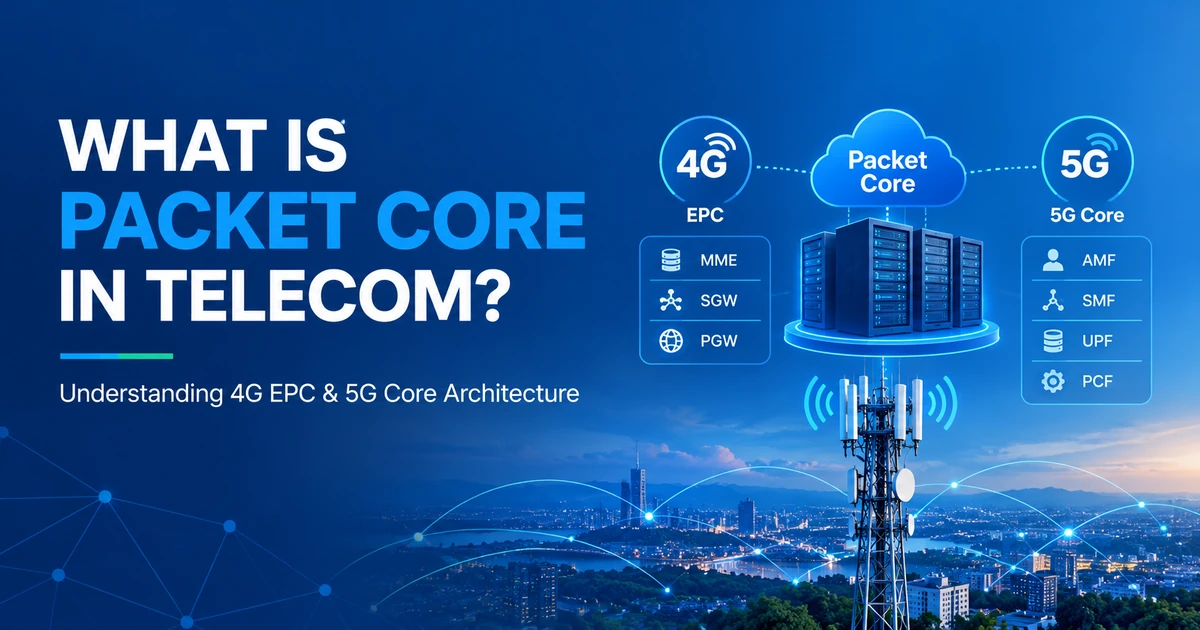
1. 4G LTE Packet Core (EPC)
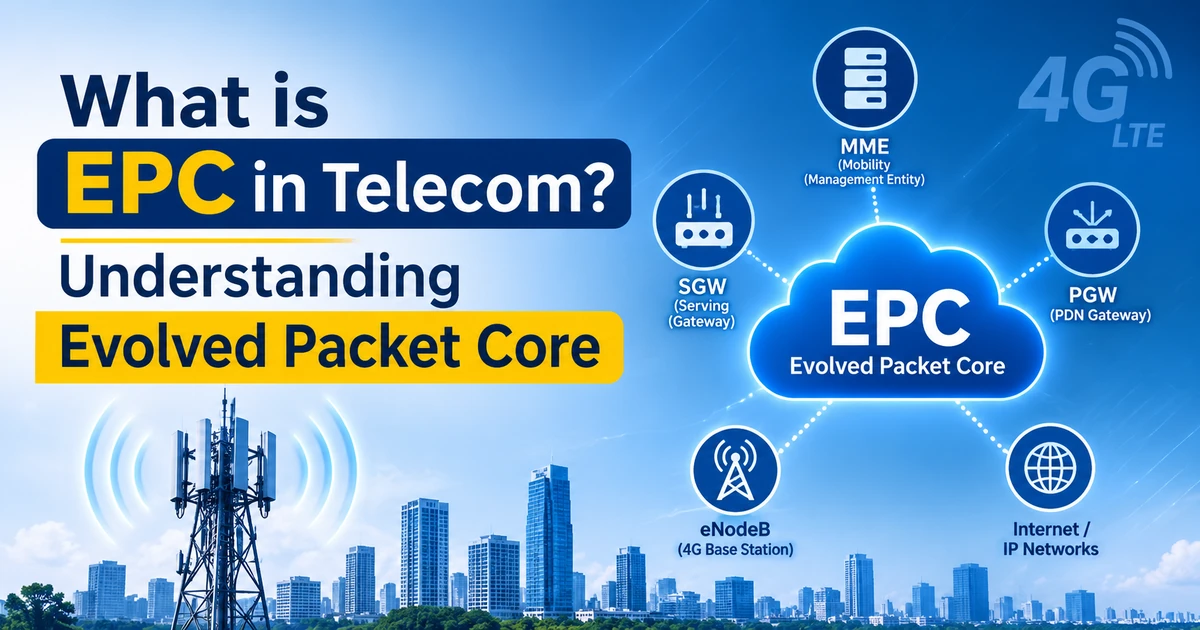
The 4G Packet Core is commonly known as the Evolved Packet Core (EPC). It was introduced as part of the LTE architecture to support high-speed IP-based mobile communication.
The major components of 4G EPC include:
Mobility Management Entity (MME)
The MME manages subscriber mobility, authentication signaling, and connection establishment. It plays a key role in controlling the signaling between mobile devices and the core network.
Serving Gateway (SGW)
The Serving Gateway routes user data packets between the LTE Radio Access Network and the Packet Core. It also supports mobility when users move between different LTE base stations.
Packet Data Network Gateway (PGW)
The PGW connects the mobile network to external packet data networks, such as the internet. It handles IP address allocation, packet filtering, and charging-related functions.
Home Subscriber Server (HSS)
The HSS stores subscriber information, authentication data, and service subscription details.
Policy and Charging Rules Function (PCRF)
The PCRF manages policy control and charging rules. It helps determine how network resources are allocated to different services and subscribers.
2. 5G Packet Core Architecture
The 5G Packet Core, also called the 5G Core (5GC), introduces a cloud-native and service-based architecture designed to support advanced connectivity requirements.
Unlike the traditional 4G EPC architecture, 5G Core uses Service-Based Architecture (SBA), allowing network functions to communicate through standardized service interfaces.
Important 5G Core network functions include:
Access and Mobility Management Function (AMF)
The AMF manages access authentication signaling, registration, and mobility management.
Session Management Function (SMF)
The SMF manages PDU sessions, including session establishment, modification, and release.
User Plane Function (UPF)
The UPF handles user data packet forwarding, routing, and traffic processing. It provides connectivity between the 5G network and external data networks.
Authentication Server Function (AUSF)
The AUSF supports subscriber authentication procedures.
Unified Data Management (UDM)
The UDM manages subscriber-related information and data used by different network functions.
Policy Control Function (PCF)
The PCF provides policy control decisions for network services and sessions.
Network Repository Function (NRF)
The NRF maintains information about available network functions and helps other network functions discover them.
What Are the Main Functions of a Packet Core Network?
A Packet Core network performs several critical functions that ensure smooth mobile communication.
1. Subscriber Authentication
The Packet Core verifies subscriber identities before allowing access to mobile network services.
2. Mobility Management
It enables subscribers to move between different network cells while maintaining connectivity and active sessions.
3. Session Management
The network establishes, maintains, modifies, and releases data sessions based on subscriber requirements.
4. IP Address Management
The Packet Core assigns or manages IP addresses so that mobile devices can communicate with external networks.
5. Data Routing and Forwarding
It routes data packets between mobile devices, network gateways, and external services.
6. Quality of Service Management
It manages traffic priorities and service quality to support different application requirements, including video streaming, voice communication, and enterprise connectivity.
7. Charging and Billing
Packet Core systems support usage measurement and charging mechanisms that help telecom operators manage subscriber billing.
8. Network Security
It supports authentication, authorization, traffic protection, and other security mechanisms to protect subscribers and network resources.
Why Is Packet Core Important in Telecom?
The Packet Core is essential because it enables modern mobile networks to deliver reliable, secure, and high-speed connectivity.
Some of its major benefits include:
1. High-Speed Data Connectivity
Packet Core enables efficient data transmission, supporting high-speed internet browsing, video streaming, online gaming, and other bandwidth-intensive applications.
2. Better Network Performance
Advanced traffic management and QoS mechanisms help telecom operators optimize network resources and deliver better service quality.
3. Seamless Mobility
Subscribers can move between network cells while maintaining their data connectivity and supported active sessions.
4. Improved Security
Authentication, authorization, and security mechanisms help protect subscribers and network infrastructure.
5. Scalability
Modern virtualized and cloud-native Packet Core solutions allow operators to scale network capacity according to changing traffic demands.
6. Support for 5G and IoT
Packet Core architecture supports advanced use cases such as massive IoT connectivity, industrial automation, smart cities, and connected devices.
Packet Core in 4G, 5G, and Beyond
The evolution of Packet Core technology has played a major role in transforming mobile telecommunications.
Packet Core in 4G LTE
The 4G LTE Packet Core, or EPC, introduced an all-IP network architecture that improved mobile broadband performance and supported services such as VoLTE.
Packet Core in 5G
The 5G Core introduces a service-based architecture, network slicing, cloud-native deployment, and flexible user-plane placement.
These capabilities support use cases such as:
- Enhanced Mobile Broadband (eMBB).
- Ultra-Reliable Low-Latency Communications (URLLC).
- Massive Machine-Type Communications (mMTC).
- Industrial IoT.
- Smart manufacturing.
- Connected vehicles.
The Future of Packet Core
Future Packet Core networks are expected to focus increasingly on automation, artificial intelligence, cloud-native technologies, network security, and distributed computing.
These advancements will help telecom operators deliver more flexible and intelligent connectivity services.
Challenges in Packet Core Network Management
Despite its advantages, managing a Packet Core network involves several technical challenges.
Some common challenges include:
Network complexity: Managing multiple interconnected network functions requires specialized technical expertise.
High data traffic: Increasing mobile data consumption creates pressure on network capacity.
Security threats: Telecom operators must continuously protect core network infrastructure against evolving cyber threats.
Interoperability: Integrating equipment and software from multiple vendors can create compatibility challenges.
Network availability: Operators must maintain high service availability and minimize downtime.
Cloud transformation: Migrating traditional network functions to virtualized and cloud-native environments requires careful planning.
Addressing these challenges is important for delivering reliable and future-ready telecom services.
Conclusion
Packet Core is one of the most important elements of modern telecommunications infrastructure. It enables mobile devices to connect to the internet, supports subscriber authentication, manages mobility, routes data traffic, and maintains network security.
From the 4G Evolved Packet Core (EPC) to the advanced 5G Core architecture, Packet Core technology continues to evolve to meet increasing demands for speed, scalability, reliability, and connectivity.
As telecom networks move toward cloud-native architectures, network automation, and advanced 5G services, Packet Core will remain a fundamental part of the global telecommunications ecosystem.
Understanding Packet Core is therefore essential for telecom professionals, network engineers, technology enthusiasts, and businesses exploring modern mobile network technologies.
Frequently Asked Questions (FAQs)
1. What is Packet Core in telecom?
Packet Core is the central part of a mobile network responsible for managing data traffic, authenticating subscribers, establishing data sessions, and connecting mobile devices to external networks.
2. What is the main purpose of Packet Core?
The main purpose of Packet Core is to manage mobile data connectivity by handling authentication, mobility, session management, IP addressing, traffic routing, and policy enforcement.
3. What are the main components of 4G Packet Core?
The main components of 4G Evolved Packet Core (EPC) are MME, SGW, PGW, HSS, and PCRF.
4. What is the difference between EPC and 5G Core?
EPC is the core network architecture used in 4G LTE, while 5G Core uses a service-based architecture with cloud-native capabilities, network slicing support, and separate control and user planes.
5. What is the role of UPF in 5G?
The User Plane Function (UPF) handles user data packet forwarding, routing, and traffic processing between the 5G Radio Access Network and external data networks.
6. Is Packet Core responsible for internet connectivity?
Yes. Packet Core provides the network functions and connectivity required for mobile subscribers to access the internet and other external packet data networks.
7. What is the difference between RAN and Packet Core?
The Radio Access Network (RAN) provides wireless connectivity between mobile devices and the telecom network, while Packet Core manages subscriber sessions, mobility, policies, and data connectivity to external networks.
8. What is cloud-native Packet Core?
Cloud-native Packet Core is a modern implementation in which network functions are designed to operate using cloud technologies, containerization, microservices, and automated orchestration.