

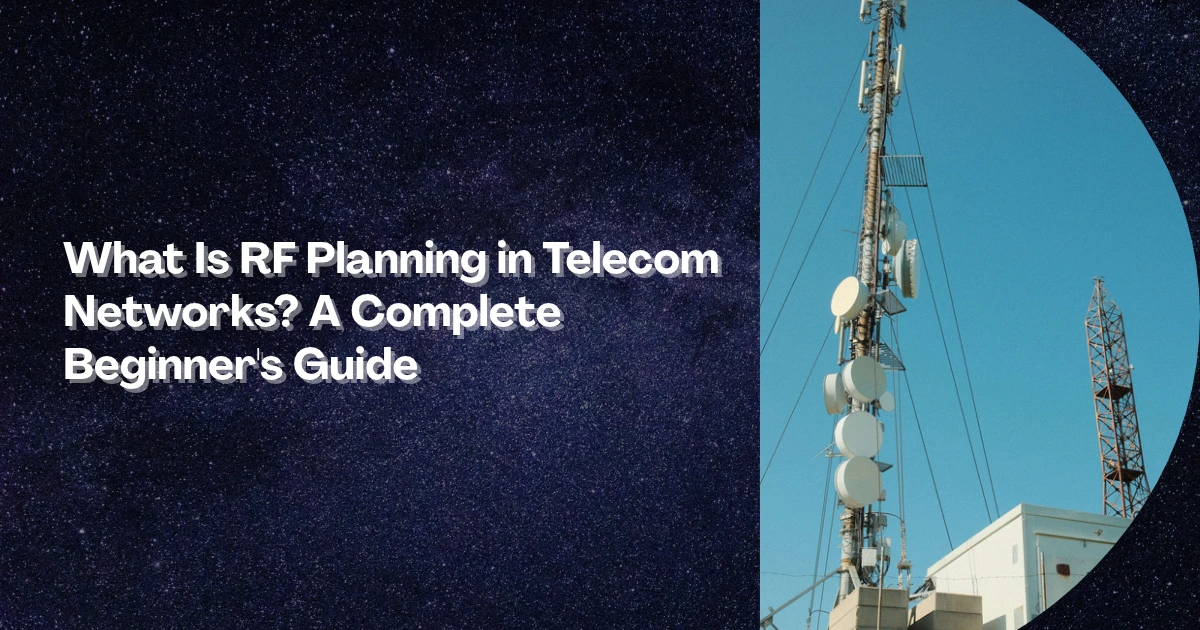
What Is RF Planning in Telecom Networks?
RF Planning (Radio Frequency Planning) is one of the most important activities in the design, deployment and optimization of cellular communication networks. It involves planning radio coverage, network capacity, frequency resources, antenna configurations and base station locations to ensure reliable wireless communication.
Whether it is a 2G GSM, 3G UMTS, 4G LTE or 5G NR network, proper RF planning helps mobile network operators deliver better signal coverage, higher data speeds, improved voice quality and a consistent user experience.
In simple terms, RF planning determines how a mobile network should be designed so that users can make calls, browse the internet and access mobile services without experiencing poor signal strength, dropped calls or network congestion.
In modern telecommunications, RF planning is not limited to selecting cell tower locations. It also includes radio propagation analysis, coverage prediction, capacity estimation, interference management, frequency planning and network performance optimization.
Why Is RF Planning Important in Telecom Networks?
Mobile networks operate using radio frequencies to transmit and receive signals between mobile devices and cellular base stations.
Without proper RF planning, a network may experience several problems, including poor indoor coverage, weak signal strength, high interference, dropped calls, slow data speeds and inefficient utilization of available spectrum.
Effective RF planning helps telecom operators achieve the following objectives:
- Better network coverage: Ensures that the required geographical areas receive sufficient radio signal strength.
- Higher network capacity: Helps the network handle increasing numbers of subscribers and data traffic.
- Reduced interference: Minimizes interference between neighboring cells and improves radio signal quality.
- Improved user experience: Supports better voice calls, faster internet speeds and reliable connectivity.
- Efficient spectrum utilization: Makes better use of available frequency bands and bandwidth.
- Optimized infrastructure cost: Helps determine the required number and placement of network sites.
The main objective is to balance coverage, capacity and quality while keeping deployment and operational costs under control.
What Are the Main Components of RF Planning?
RF planning involves several technical activities that work together to build an efficient radio access network.
1. Coverage Planning
Coverage planning determines the geographical area that should receive adequate radio signal from a cellular base station.
RF engineers analyze terrain, buildings, population density, antenna height, transmit power and propagation characteristics to predict the coverage area of each cell.
Common coverage-related parameters include:
- RSRP (Reference Signal Received Power)
- RSRQ (Reference Signal Received Quality)
- SINR (Signal-to-Interference-plus-Noise Ratio)
- RSSI (Received Signal Strength Indicator)
Coverage planning is essential for identifying weak signal areas, coverage holes and areas requiring additional sites or network improvements.
2. Capacity Planning
Capacity planning estimates how much network traffic a cell or group of cells can handle.
As the number of mobile subscribers increases, network traffic also increases. RF engineers analyze expected user demand, busy-hour traffic, available spectrum, bandwidth and radio resource utilization.
Capacity planning helps determine whether additional carriers, sectors, small cells or other network upgrades are required.
3. Frequency Planning
Frequency planning involves assigning and managing radio frequency resources to minimize interference and improve network performance.
In traditional GSM networks, frequency allocation and reuse planning are particularly important.
In LTE and 5G networks, operators generally use frequency reuse-1 within a carrier, while interference coordination and radio resource management help control interference between cells.
4. Antenna Planning
Antenna planning determines the appropriate antenna type, height, orientation and configuration for each base station.
Important antenna parameters include:
- Azimuth
- Mechanical Tilt
- Electrical Tilt
- Antenna Height
- Horizontal Beamwidth
- Vertical Beamwidth
- Antenna Gain
Correct antenna configuration helps improve coverage distribution and reduce unwanted interference.
5. Interference Planning
Interference occurs when unwanted radio signals affect the communication between a mobile device and its serving cell.
RF engineers analyze interference patterns and identify possible sources of degradation.
Common interference management techniques include antenna optimization, power adjustments, frequency coordination and interference coordination mechanisms.
6. Neighbor Planning
Neighbor planning defines relationships between neighboring cells to support mobility procedures.
When a mobile user moves from one cell to another, the network needs appropriate neighbor information to support handover or cell reselection.
Incorrect neighbor configuration can contribute to handover failures, call drops and mobility problems.
What Is the RF Planning Process?
RF planning generally follows a structured process, starting from initial network dimensioning and continuing through detailed planning, validation and optimization.
Step 1: Network Dimensioning
Network dimensioning estimates the number of sites, sectors, carriers and radio resources required to support the expected coverage and traffic demand.
Step 2: Site Selection and Survey
RF engineers identify suitable locations for base stations by considering geographical conditions, existing infrastructure, population distribution and network requirements.
Step 3: Radio Link Budget Analysis
A radio link budget calculates the expected signal power at the receiver by considering transmitter power, antenna gains, feeder losses, propagation losses and receiver characteristics.
Step 4: Coverage Prediction
Planning tools and radio propagation models are used to estimate signal coverage and identify potential weak coverage areas.
Step 5: Capacity and Frequency Planning
Engineers estimate traffic demand and configure available radio resources to meet network requirements.
Step 6: Network Implementation
The planned network configuration is implemented at the selected sites, including antenna installation and radio equipment configuration.
Step 7: Drive Testing and Validation
Drive testing and field measurements help verify whether the actual network performance meets the planned coverage and quality targets.
Step 8: RF Optimization
Engineers analyze network performance and make necessary adjustments to antenna parameters, power levels, mobility settings and other radio configurations.
RF planning is an iterative process. Network performance must be monitored and optimized as traffic patterns, subscriber demand and network configurations change.
RF Planning in Different Mobile Network Technologies
RF planning techniques vary depending on the mobile network generation and its radio access technology.
Technology RF Planning Focus
2G GSM Frequency reuse, BCCH, BSIC and coverage
3G UMTS Pilot power, scrambling codes and interference
4G LTE RSRP, RSRQ, SINR, PCI and PRB utilization
5G NR Beamforming, Massive MIMO, SSB, SINR and bandwidth
RF Planning in 2G GSM
GSM RF planning focuses on frequency allocation, frequency reuse, BCCH planning, BSIC planning and interference management.
RF Planning in 3G UMTS
UMTS planning focuses on pilot power, scrambling codes, coverage, interference and soft handover.
RF Planning in 4G LTE
LTE RF planning involves PCI planning, coverage prediction, reference signal power, interference management and capacity planning.
RF Planning in 5G NR
5G RF planning introduces additional considerations such as Massive MIMO, beamforming, advanced antenna configurations, wider bandwidths and higher-frequency spectrum.
Common RF Planning Tools
Telecom engineers use specialized RF planning and optimization tools to design, simulate and analyze cellular networks.
Some commonly used tools include:
- Atoll.
- Planet.
- Mentum Planet.
- TEMS Investigation.
- Nemo Outdoor.
These tools support activities such as coverage prediction, propagation modeling, network planning, drive-test analysis and performance optimization.
What Skills Are Required to Become an RF Planning Engineer?
To work as an RF Planning Engineer in the telecommunications industry, professionals should develop knowledge of radio frequency fundamentals, cellular network technologies and network planning methodologies.
Important skills include:
- Understanding GSM, UMTS, LTE and 5G NR architecture.
- Knowledge of radio propagation and path loss models.
- Understanding antenna parameters and radio link budgets.
- Knowledge of coverage and capacity planning.
- Understanding frequency, PCI and neighbor planning.
- Experience with RF planning and drive-test tools.
- Ability to analyze network KPIs and troubleshoot coverage issues.
Practical experience with RF planning software and real network performance data is particularly valuable.
Conclusion
RF planning is a fundamental part of building reliable and efficient cellular communication networks. It ensures that mobile operators can deliver adequate coverage, sufficient capacity and acceptable signal quality while making efficient use of available radio resources.
From initial site selection and coverage prediction to frequency planning, drive testing and network optimization, every stage contributes to the overall performance of a mobile network.
As telecommunications technology continues to evolve from 4G LTE to 5G and beyond, RF planning will remain an essential engineering discipline for delivering high-quality wireless connectivity.
For telecom professionals, understanding RF planning fundamentals is an important step toward developing expertise in radio network design, deployment and optimization.
Hi, this is a comment.
To get started with moderating, editing, and deleting comments, please visit the Comments screen in the dashboard.
Commenter avatars come from Gravatar.